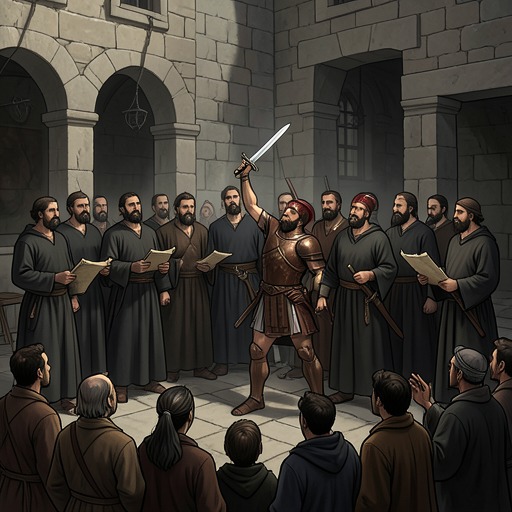
Paul before the Sanhedrin
Acts of the ApostlesPaul before the Sanhedrin is a hearing that exposes a gap between an institution’s judicial purpose and its conduct. Convened to clarify the charges against Paul, the council instead becomes a scene of accusation, procedural failure, and factional conflict. Paul’s defense draws on both his integrity and his Jewish commitments; his appeal to the resurrection then divides the council, and the resulting disorder prompts the tribune to protect him. The episode also requires readers to reckon with the account’s polemical treatment of Jewish leadership and to avoid treating it as a reliable portrait of the council or of Jews as a whole.
The hearing and its procedural failure
The tribune orders the Jewish council to convene to determine the charges against Paul, effectively assigning it the task of a grand jury. The council does not carry out that task in an orderly way. Instead, the narrative presents it as divided and ineffective, and as violating the very principles by which it should assess a case. The hearing is therefore more than a dispute over Paul’s beliefs: it tests whether an institution entrusted with judgment will observe its own standards.
Paul says that he has lived with a clear conscience. His claim covers both his earlier work as a persecutor and his present work as a preacher: in each period, he says, he acted faithfully toward God’s purpose as he understood it. The account presents this as a statement of integrity, not as a claim that his role or understanding never changed. It gives the hearing a personal as well as procedural stake: Paul is defending the continuity of his commitment even as his public mission has changed.
The high priest responds by ordering those standing near Paul to strike him, rejecting his claim before any witnesses have been heard. Paul answers by invoking the image of a whitewashed wall from Ezekiel: a structure whose poor construction is concealed until a deluge brings it down. The image makes the council’s failure an indictment of appearances. Its authority cannot make its proceedings sound when it treats an accused person as guilty without first hearing evidence.
Paul’s Jewish commitments and the council’s conflict
Bystanders accuse Paul of insulting the high priest. Paul replies that he did not realize he was addressing the high priest and cites Exodus 22:28 to indicate that he would not knowingly violate Jewish precedent. The exchange complicates any simple opposition between Paul and Judaism: although he is on trial, he presents himself as someone who recognizes the standards the council itself has failed to honor. In the account’s contrast, the council accuses without witnesses, while Paul affirms the obligation to respect its law.
Paul then notices that the council includes both Pharisees and Sadducees. He identifies himself as a Pharisee on trial because of the resurrection, making a shared religious dispute the point around which the hearing turns. Dissension breaks out because the Sadducees do not accept end-time theology or resurrection of the dead, while the Pharisees do. Paul’s rhetorical move redirects the proceeding from the charges against him to disagreement within the body hearing him.
The Pharisees say they find nothing wrong with Paul and allow that he may have received a message from an angel or a spirit. This is the account’s final direct reference to the Pharisees, and it leaves them in a relatively favorable light. The scene thus does not present every Jewish participant as aligned against Paul: disagreement within the council matters to the outcome, and some members speak in his defense.
Disorder, protection, and the journey toward Rome
The dissension grows so violent that the tribune fears Paul will be torn apart by the crowd. He removes Paul from the scene and sequesters him, once again acting as a source of immediate protection. That intervention does not erase the council’s failure; it shows how the hearing’s collapse leaves Paul dependent on Roman authority to prevent further harm.
That night, the risen Jesus stands near Paul, encourages him to be courageous, and tells him that he will bear witness in Rome. The assurance gives the episode a forward direction: the council’s disorder does not end Paul’s mission, but becomes part of the circumstances through which the narrative moves him toward Rome. The hearing is one point in a larger sequence in which some Roman officials and legal protections provide Paul with safe passage, even though the Roman system does not guarantee justice.
The account later shows the limits of that protection. Paul’s Roman citizenship halts an impending flogging in Jerusalem, and he eventually appeals to the emperor, a right associated with his citizenship. That appeal helps prevent a plot against him from succeeding and advances his journey to Rome, but the legal process still fails to exonerate him: Festus knows he lacks Roman grounds for sending Paul to Rome, yet feels obligated to forward the case and seeks help formulating charges. The narrative therefore distinguishes protection from justice. Roman authority can shield Paul from particular threats and carry him toward his destination without ensuring a fair resolution.
Narrative framing and responsible interpretation
The account’s portrayal of the council is openly polemical, and the commentary on the episode warns that it should not be allowed to stand as an accurate picture of the council. Without that qualification, a sermon or retelling risks reinforcing anti-Judaism and antisemitism. The scene is evidence of how this narrative frames a particular conflict, not grounds for treating Jewish people as a single group or for transferring the conduct attributed to these leaders to Judaism as a whole.
The council’s treatment of Paul also supports a pointed institutional comparison. In a chiastic parallel with the choosing of the apostles and their teaching and healing in Luke, the council is set against the leadership associated with Paul’s mission. The apostles help sustain a community and its witness; the council, in this scene, falls into dissension and fails to follow its own legal procedure. The comparison asks what kind of leadership an institution serves: whether its authority supports a community’s witness or betrays its stated commitments.
The episode’s critical force consequently applies beyond the council. Paul’s image of the whitewashed wall invites scrutiny of any institution that looks sound while neglecting the principles it claims to uphold. The high priest’s premature assumption of guilt also makes the failure of judgment concrete: accusation precedes evidence, and the hearing becomes a contest of power rather than a careful examination of a case. Read with its historical and polemical limits in view, the scene can prompt reflection on fair procedure, responsible public discourse, and solidarity with Jewish communities, including occasions when Jewish leaders and communities have stood with the church despite a long history of Christian hostility.